What were you doing when you were 18? I for one was spending most of my time lounging in front of the TV, avoiding schoolwork like the plague, and partaking in other unmentionable activities…
I certainly wasn’t playing in the final of a Grand Slam.
The same cannot be said for Britain’s 18 year old tennis starlet Emma Raducanu, who finds herself making history with every serve, volley, and winner she’s played en route to the 2021 US Open final.
Emma Raducanu announced herself to the world as she reached the fourth round at Wimbledon earlier in the summer.
It’s been at the US Open however that she’s taken the world by storm. Becoming the first qualifier in history, men’s or women’s, to reach the final of a major, Raducanu finds herself on the brink of writing her name into tennis folklore forever.
A win tonight would see her pull off one of the most incredible feats in sporting history.
Leylah Fernandez will face off against Emma Raducanu in the US Open final.
The woman standing in her way? Canada’s Leylah Fernandez, who is.. 19 years old. Yes, both 2021 US Open finalists are in their teens. Makes you sick, doesn’t it?
The last Grand Slam final to feature two teenagers was over twenty years ago, when Serena Williams beat Martina Hingis to win her first Grand Slam in 1999. One of the most dominant athletes in history in Serena Williams, and Hingis a 7 time Grand Slam winner. Undoubtedly two of tennis’s greatest competitors.
Martina Hingis and Serena Williams, finalists of the 1999 US Open. Williams would secure her first of 23 (and counting) Grand Slam titles.
It begs the question then; are we witnessing the genesis of tennis’s next superstars?
Raducanu has certainly been on a stratospheric trajectory this year, and at just 18 years of age, one has to wonder what more we’re going to see her achieve throughout her career.
Entering the WTA rankings at a modest 727 in 2017, Fernandez too has enjoyed a remarkable rise to stardom. Ranked 66th in the world now, an improvement of over 650 places in just five seasons, suggest this Grand Slam final is just the first of many.
Fernandez has risen the WTA rankings at a rapid rate.
There can of course only be one winner, but no matter which of these prodigious stars emerges victorious from Flushing Meadows, we can rest assured that the future of female tennis, and tennis as a whole, is in very safe hands.
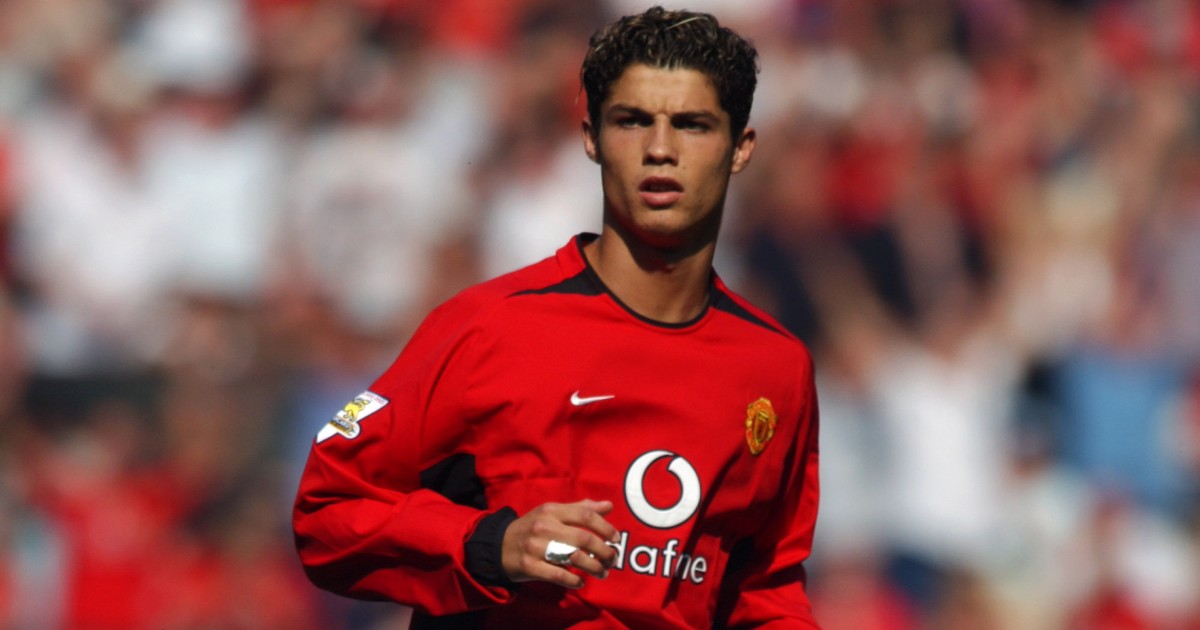
A sensational transfer in its own right, United fans will savour it all the more given that it appeared Ronaldo was snatched from their cross-city rivals at the eleventh hour.
Patrice Evra takes to Instagram to post messages between himself and Ronaldo before the deal to return to United was announced.
It soon became apparent that the powers that be at United couldn’t stomach this possibility either. According to most media outlets, United legends and current players alike were instrumental in hijacking Ronaldo’s potential move to City, convincing him to return instead to Old Trafford.
So, three weeks and an international break later, we find ourselves on the eve of Ronaldo’s second United debut.
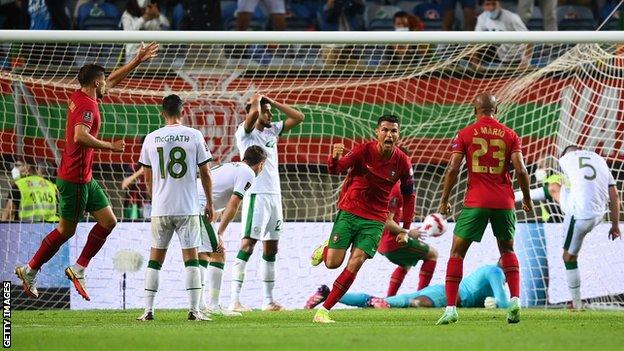
Ronaldo scored his 110th and 111th goals for Portugal against the Republic of Ireland during the international break, breaking Ali Daei’s international goalscoring record.
For years there has always been speculation about whether Ronaldo would return to the club in which he made his name. Most transfer windows saw ludicrous speculation on his future at Real Madrid and his relationship with the manager or president, and the more gullible of United fans would rub their hands together waiting for Ed Woodward to pounce.
I never wanted him to re-join United. I had visions of him coming back to Old Trafford and being a shadow of his former self, unable to live up to the weight of expectation that would inevitably come with his return. I fully expected him to join a long line of Manchester United flops, and tarnish his legacy as a United player.
Alexis Sanchez failed to live up to expectation at Old Trafford, joining a long list of flops at the club.
Now however, I find myself holding a very different opinion. As I consider the queries and questions of those pundits who doubt what Ronaldo can bring to the Manchester United side, I find it difficult to care. Where once I would have been wrought with anxiety about Ronaldo’s legacy being left in tatters, the nature of his transfer this summer has dispelled any of these fears.
Coming a hair’s breadth from having to watch one of our greatest ever players don that abhorrent City third shirt has put the idea of a ‘legacy’ very much in perspective.
New Manchester City signing, Jack Grealish, sporting the club’s 3rd shirt for the 2021/22 season. A true shocker.
If Ronaldo scores just three goals from the penalty spot and one more from open play during the course of his two year spell back at the club, the impact this will have on his legacy pales in comparison to the irreparable damage playing for Manchester City would have done.
So, as Old Trafford prepares to welcome Ronaldo back tomorrow, I plan on sitting back and enjoying the ride, for good or ill. It will be a pleasure to watch him pull on the famous red shirt of Manchester United once again.
Rio Ferdinand discusses one of Ronaldo’s greatest goals for Manchester United.
Never before have I envied those that aren’t sports fans, those that have found contentment in life without vehemently lauding or loathing other grown men and women for running around a court, pitch, or track.
Yet that is the position I’ve found myself in during the past few months. As the Coronavirus pandemic brought all facets of normal life to an abrupt halt, it was live sport that I found myself longing for the most.
The NFL Draft, the return of the Bundesliga, and Netflix’s smash-hit docuseries, The Last Dance, which follows Michael Jordan’s 1998 season with the Chicago Bulls, have done what they can to whet my appetite.. but Jesus Christ, I miss sports.
Netflix’s The Last Dance brought Michael Jordan’s career with the Chicago Bulls to an entirely new audience.
So, whilst we await the return of normality, I’ve decided to put together a list of the top 10 sporting moments of the 21st Century. At this point I’d point out that these are my top sporting moments, not necessarily those of general consensus. There could well be some glaring omissions from the list, and if you feel that strongly about it you can send me a message that I absolutely *will not* ignore.
Without further ado, we’ll crack on with the list.
10. Van Gerwen’s Perfect 17 Darts
Atmosphere alone propels this one into my top ten.
But first, allow me to lay down some background for those disinterested in darts. Each player starts a leg on 501, and they are aiming to ‘check it out’ in as few darts as possible. The minimum amounts of darts a player must throw in order to check out 501, is 9.
The Netherland’s Michael van Gerwen is viewed by many as the greatest darts player of all time.
There are 3,944 ways to check out a leg in 9 darts, which sounds like quite a lot, doesn’t it? But those are just the mathematically possible variations. A number which might put the scale of a nine dart finish in better perspective, is 315. That is the number of nine dart finishes in PDC history since 1999. Only 315.
To further illustrate the difficulty of a 9 dart finish, they are often compared to a 147 break in snooker, and sometimes even to a hole in one in golf; two of the most difficult feats in sport. All three require absolute perfection, there is no room for error.
Now, in the semi-final of the PDC 2013 World Championship, Michael Van Gerwen was pitted against James Wade, two of darts’ biggest names. Van Gerwen found himself 3 sets to 1 up against Wade, but 2 legs down in the 5th set. I implore you to watch the video below to watch what happened next.
Michael van Gerwen throws 17 perfect consecutive darts.
Absolute ecstasy. Darts fans may never see a 9 dart finish in their entire life, and the patrons of the packed Alexandra Palace in London were millimetres away from seeing two in consecutive legs.
P.S. You’ll be hard pressed to find a better piece of commentary than that.
9. Aguero’s League Winner
A painful one for me to admit.. but the sheer and utter elation that erupted across the Etihad when Sergio Aguero hammered home the winner against QPR on the final day of the season is what sport is all about.
This moment will be immortalised in Premier League folklore, and rightly so. For the first time in 44 years, Manchester City were League Champions, finally overcoming their dominant city rivals, United.
The manner in which this season’s title race was decided will live long in the memories of football fans up and down the country. With only a win good enough for City, wave after wave of their attacks broke against the stubborn QPR defence, until, with what was likely to be one of the last kicks of the game, Sergio Aguero thumped home the game – and league – winner, sending the Etihad into rapturous celebrations.
Furthermore, very few commentators would have been able to accurately capture and convey the feelings of football fans in this moment the way Martin Tyler did.
8. Stefon Diggs Calls Game
A personal favourite, this one will stick with me for a long time, given the circumstances in which, and the people with whom, I saw it.
Minnesota’s Stefon Diggs makes the last minute catch against the New Orleans Saints.
Allow me to set the scene; The dying moments of the NFC Championship game between the Minnesota Vikings and the New Orleans Saints. Vikings are down by 1. It’s 3rd and 10 with just 10 seconds left on the game clock.
The Vikings have time to run two plays; one to get them within field goal range, and another to kick what would likely be the game winning field goal. It sounds simple when you break it down into layman’s terms, but believe me, every betting man in the country would have backed the Saints to hold them at bay.
Vikings quarterback, Case Keenum, drops back into the pocket and surveys his options. He fires the ball deep towards wide receiver Stefon Diggs on the touchline. Diggs *just* has to catch it and get out of bounds, stopping the clock, and allowing the special teams unit to step up and kick the clutch field goal.
That alone would be an incredible finish to the game, but of course it doesn’t play out like that. As Diggs reels in the catch, every Vikings coach, player, and fan across the country were screaming at him to get out of bounds before being tackled. Diggs however had other ideas. He had the presence of mind to realise that a Saints defender had made a crucial missed tackle, giving him a free run to the endzone; an opportunity to win it, there and then.
Diggs takes the catch to the house, sending Minnesota through to the next stage of the playoffs.
The stadium erupts, Joe Buck – the commentator – loses his mind, and Diggs removes his helmet, revealing the face of the most composed man in the stadium.
Moments like these are why sport is such an infectious and addictive pastime for people across the world. The opportunity to overcome the impossible. To be able to be a part of that, to have even been able to see it? Priceless.
7. Barcelona’s Impossible Comeback
Paris St. Germain fans will look back at this moment through their fingers, as they try to come to terms with what happened at the Nou Camp in March of 2017.
The most prestigious of club competitions in world football, the Champion’s League had seen some of the greatest moments in footballing history. The second leg of the round of 16 would provide what might be the most spectacular.
Having been soundly thrashed 4-0 in Paris, Barcelona were all but out of the competition. A disappointing early exit beckoned, with the second leg being seen by many as little more than a formality.
PSG celebrate thrashing Barcelona 4-0 in the first leg.
The Blaugrana had other ideas. Owing to perhaps the most deadly attacking trio world football has ever seen, Neymar, Suárez, and the greatest of all time, Lionel Messi, Barcelona summoned one of the most improbable performances ever seen to progress to the quarter finals.
An early goal from Luis Suárez gave the home side a glimmer of hope, and at 3-0 after 50 minutes, they were well and truly in the game. However, when PSG’s Edinson Cavani thumped the ball into the back of the net in the 62nd minute, all optimism within the Nou Camp evaporated.
With under 30 minutes remaining, and needing three goals to progress owing to the away goals rule, Barcelona’s valiant efforts appeared to be for nought.
A sublime free kick from Neymar in the 88th minute looked to be little more than a consolation, but when he tucked home a penalty in the first minute of stoppage time, the stadium erupted as the fans begged their team to produce one last moment of brilliance.
Five minutes of injury time were to be played. Ample time for a team of Barcelona’s calibre to produce just one opportunity, one half chance that might send them through. The seconds ticked by, and as the eleventh hour arrived, Sergi Roberto, an unlikely hero, arrived to prod home a hopeful ball.
Comebacks can happen often in football. It’s a sport that lends itself to immediate instances of change and opportunity. Rarely however does it produce comebacks of this proportion. Becoming the first team to overturn a 4-0 first leg deficit in Europe since 1955, Barcelona offered us a reminder that impossible is little more than a word.
Highlights from Barcelona’s memorable win.
6. Usain Bolt’s Olympic Dominance
When Jamaica’s Usain Bolt strolled across the 100m finish line in Beijing’s Birds Nest Stadium at the 2008 Olympics, he announced himself to the world as the fastest man on the planet. Setting a then world record pace of 9.69 seconds, the world didn’t wonder how he ran so fast, they wondered how fast could he go?
You see, at 80 metres, Bolt knew he had won. Lengths ahead of the competition, he could afford to look to either side, and outstretch his arms in celebration. He was actually slowing down before he had crossed the line.
Usain Bolt demolishes the competition in the 100m sprint at the 2008 Olympics.
Coming away with the top prize in all three of the major track sprints (100m, 200m, and 4x100m relay) in 2008, athletics had found an icon. Not only had he shown his class on the track, but he had won the hearts and minds of fans across the world with his personality and infectious smile.
Having set a new world record of 9.58 seconds earlier in the year, the London 2012 games saw Bolt presented with an opportunity, not only to defend his three titles, but to distribute what many might have called justice to America’s Justin Gatlin, as he returned from his second ban for doping. Gatlin entered the Olympics in red hot form, and many feared that he would take home the gold in the 100m event.
Bolt remained the coolest man on the planet however, as he took his place in the starting blocks. 9.63 seconds later he had dispensed with Gatlin and his compatriot Yohan Blake, claiming his second Olympic 100m gold medal in as many attempts. Success in the 200m and 4x100m relay would see all three of his titles defended.
Bolt daps up an Olympic volunteer moments before taking home gold in the 2012 200m race.
Well and truly an international superstar, Bolt had entered the twilight of his career as he arrived at the Rio 2016 games. There was no question that this would be his last Olympics, but at the wrong end of 29, could he still compete with the rising stars of international sprinting?
Justin Gatlin too was hoping to improve on his 3rd place finish four years earlier, and with an electric start, it looked like he would finish atop the podium. With 50 metres to go however, Bolt powered into the lead, leaving Gatlin and the rest of the competition in the dust for the final time.
The first athlete to win three successive Olympic titles in the 100m event, as well as two more successive wins in the 200m and 4x100m relay, Usain Bolt completed an historic ‘treble treble’. Unfortunately, this accolade would be tarnished and removed by the retrospective ban of his 2008 relay teammate Nestor Carter, resulting in the Jamaican team being stripped of their gold medal.
Usain Bolt will be remembered as one of the greatest athletes of all time. His incredible speed was matched only by his captivating personality, and I suspect it will be a long time before the most exhilarating event in all of athletics meets a character as impressive or as likeable as Bolt.
An iconic image. Usain bolt smiles as he leads from the front of the 100m final at the 2016 Rio Olympics.
5. Andy Murray Winning Wimbledon
For years Andy Murray had been seen as this emotionless figure, a man whose grumpy demeanour seemed to alienate a lot of people. British fans wanted someone they didn’t just have to support through patriotic fervour, they wanted someone they could like. Murray struggled to fit this bill for many people.
It was in 2012, at Wimbledon’s Centre Court, that this perspective of Murray was changed. Having fallen agonisingly short in three previous Grand Slam finals, Murray desperately hoped that this, his fourth, would be the moment he became Britain’s first Grand Slam winner since Virginia Wade in 1977.
Once again, Murray would fall at the final hurdle. Facing the great Roger Federer, he lost in four sets. It was in the moments afterwards however, that the tennis world would bear witness to a side of Murray that hadn’t been seen before.
As he struggled through one of the most emotional interviews of his life, there was a clear shift in attitude towards Murray. Here was one of Britain’s greatest athletes, a man playing at the highest level of the game, stripping himself bare for the world to see. He had come so close so many times, and still he had not succeeded.
Heartbreak for Murray as he loses his fourth Grand Slam final to Roger Federer at Wimbledon.
In his failure, and in his response to that failure, Andy Murray offered a rare opportunity for people around the world not to sympathise with him, but to empathise. We have all tried and failed. Each and every one of us knows how it feels to fall short of something we desperately want. In that moment, as he shed tears for all to see, we felt we had something in common with Andy Murray.
Little did he know just how soon his efforts would pay off. Returning to Wimbledon that same summer, Murray took home a gold medal from the London 2012 Olympic Games. Just over five weeks later, he defeated Novak Djokovic in 5 sets to win his first ever Grand Slam, the 2012 US Open.
The following summer, Murray was presented with an opportunity to dispel his Wimbledon demons of the year before. Facing Djokovic once again, the same opponent he overcame at Flushing Meadows, there was a clear bias amongst the 15,000 Centre Court fans.
A straight sets win seemed almost to do the moment an injustice, but in just over three hours, Murray wrote himself into the history books as the first British man to win at Wimbledon since Fred Perry 77 years earlier.
The moment Andy Murray become the first male Briton to win at Wimbledon in 77 years.
Through his failures, Murray proved himself a far more complex and far more human character than anyone had imagined, and his eventual success at the US Open and Wimbledon marked some of most deserving moments of a sporting career that I can remember.
4. Iliud Kipchoge’s sub 2 hour marathon
“He had pace setters”, “It was on perfectly flat ground”, “He was wearing trampolines on his feet”, “The record doesn’t actually count”.
You could say literally anything to try and diminish the fact a man ran a sub 2 hour marathon, and I honestly couldn’t care less. Ok, maybe if you’d told me he’d pumped himself full of PEDs that would change things, but you know what I mean.
On the 12th of October, 2019, Kenyan long distance runner Eliud Kipchoge took to the streets of Vienna in a bid to become the first man to run a marathon in under 2 hours, a feat that had eluded him for over 8 years.
His attempt took place in Austria during the Ineos 1:59 Challenge, an event designed specifically for Kipchoge’s effort. Many of the variables that could affect his time were assessed and controlled as much as possible to give him the best chance of succeeding, including the terrain, the time of year, and the air quality. In addition to this, Kipchoge ran behind a pace setting car that beamed a green laser beam on the floor, as well as being joined by a team of 42 world class calibre pace setters over the course of the 26.2 miles.
Kipchoge, wearing white, is surrounded by pace setters as he attempts to run a marathon in under 2 hours.
To truly appreciate the speed of this pace, I recommend you watch the video below, posted by YouTuber Mike Boyd, as he and a few other average runners attempt to maintain the required pace.
YouTuber Mike Boyd shows just how fast Kipchoge’s pace was.
So, as Kipchoge crossed the finish line in Vienna with a time of 1:59:40, he succeeded in shattering the belief held by so many, that such a feat was impossible. Like Sir Roger Bannister 65 years earlier, Kipchoge proved that humans are defined, not by what we are told can be done, but by what we endeavour to do.
Following the race, Kipchoge said that he “can tell people that no human is limited”, a response that inspires and challenges us, not necessarily even to succeed, but simply to try. Without trying, we will never know what we can achieve.
Kenya’s Iliud Kipchoge, the man who ran the first ever recorded sub 2 hour marathon.
3.Leicester City Win The League
Is this the greatest Cindarella story in world sport? After surviving the relegation battle of the 2014/15 season by the skin of their proverbial teeth, Leicester City pulled off the most unlikely of turnarounds as they were crowned Premier League Champions the very next season.
Heading into the 2015/16 season, The Tinkerman, Claudio Ranieri, was brought in to try and steady the almost sunken ship, a decision that raised a few eyebrows, seeing as he was sacked as head coach of the Greek international team following an embarrassing loss to the Faroe Islands.
At 5000/1, The Foxes were all but written off by the bookmakers at the start of the season, but it wasn’t until the 7th game of the season that they tasted their first league defeat. Instead of rolling over for the traditionally dominant teams at the first sign of trouble, Leicester used this defeat as motivation to improve, rattling off four straight wins as they maintained their excellent start to the season.
This stellar start was due in large part to the imperious form of striker Jamie Vardy, a player who just five years earlier was playing for non-league side, Stocksbridge Park Steels. Scoring in a 1-1 draw with Manchester United, Vardy extended his consecutive goal scoring record to eleven games, breaking former United man Ruud van Nistelrooy’s record of ten.
Leicester’s Jamie Vardy scored 24 goals during the 2015/16 Premier League campaign.
It seemed impossible that Leicester could maintain this form throughout the season, and a run of games in February against Liverpool, Manchester City, and Arsenal would surely prove to be the undoing of Ranieri’s side. However, with wins against Liverpool and City, Leicester sat five points clear of Arsenal before travelling to the Emirates on February 14th.
An agonising last minute defeat to the Gunners saw the gap cut to just two points, but it turned out that Arsenal’s North London rivals, Tottenham, would provide the greatest challenge to Leicester’s title run.
This challenge too came-a-cropper when a stunning solo goal from Chelsea’s Eden Hazard sealed a late draw against Tottenham. Leicester mathematically could not be overtaken. They had succeeded in completing the most remarkable Premier League win in history.
Former Leicester City player Gary Lineker remarked halfway through the season that if Leicester could manage to win the league, he would present Match of the Day in his underwear. It wasn’t just the bookmakers that had to shell out on a few unlikely bets.
Match of the Day’s Gary Lineker presents the programme in his underwear following Leicester’s Premier League success.
2. Tiger’s Comeback
Arguably the greatest golfer of all time, Tiger Woods’ career began to unravel in 2009 when he was accused of having an extra-marital affair, as well as being involved in a car accident outside of his house.
Injuries plagued his career as things went from bad to worse in his personal life, culminating in an infamous DUI charge in 2017 as he failed multiple sobriety tests after having been found asleep at the wheel of his vehicle.
Woods’ infamous mugshot following his arrest for driving whilst under the influence.
2016 saw Woods fall outside of the world’s top 500, and in 2017 he underwent a fourth surgery on his chronically injured back. The golfing world had moved on from Tiger Woods. The likelihood of any sort of comeback, let alone tournament success, was next to nil.
As the year went on, he continued to show some semblance of form. Tying for 6th at the Open Championship and finishing second at the PGA Championship, just 2 shots off winner Brooks Koepka, we were beginning to see glimpses of the Tiger Woods of old.
It wasn’t until September 23rd however that the inconceivable comeback really became a reality, as Woods won the Tour Championship at East Lake Golf Club. I will never forget the scenes as thousands upon thousands of fans followed Woods up the 18th fairway to the green, where he made a simple two put to seal his 80th career win.
Woods’ comeback finally reached its zenith in 2019. Going into the final day of The Masters just 2 shots off the lead, golf fans across the world recognised a chance for Woods to seal a momentous win in one of golf’s greatest tournaments.
As the day went on, Woods refused to fall away, staying within touching distance of the lead. Going into the back nine just one shot off leader Francesco Molinari, Woods held a 23.4% chance of winning the Green Jacket.
It wasn’t until the par 3 16th before we really began to believe he might do it. With what might be considered the shot of the tournament given what was at stake, Woods’ tee shot came within inches of rolling in for a hole-in-one.
I remember watching this, feeling the goose bumps on my arms as I realised the enormity of what I was witnessing. Golf’s greatest icon, returning triumphant from purgatory.
Tapping in the final putt on the 18th green to seal one of the greatest comebacks in all of sport, Tiger Woods overcame a plethora of demons. From the lowest ebb to the highest peak, Woods’ rise, fall, and return will be recognised as one of sport’s greatest accomplishments
Woods taps in the final putt on the 18th at Augusta to win his 15th career major.
1. Ben Stokes and Jack Leach
“Cut away! Cut away for four!”
The images are already replaying in your mind aren’t they? The moment one man overcame the impossible.
What Ben Stokes achieved that day transcended the Ashes series and it transcended even cricket. It was one of those rare moments in sport, an act of raw defiance in the face of certain failure.
Hope crept into the hearts and minds of the England fans as Stokes chipped away at the Australian lead, only for it to crash down around them, like Sisyphus and his stone, as batsman after batsman fell afoul of the Aussie attack.
However, as the minutes and the overs ticked agonisingly by, Stokes continued to despatch balls to the boundary in spellbinding fashion. Only a man in imperious form would dare play some of the shots that Stokes did.
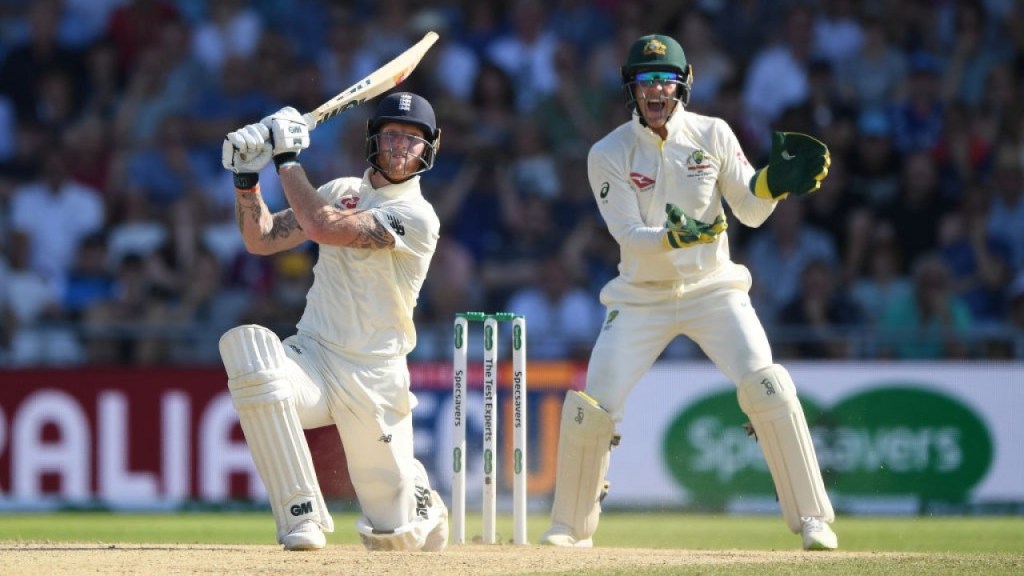
Ben Stokes and Australian captain, Tim Paine, watch on as a ball flies to the boundary.
But Stokes couldn’t have done it alone. When the chips were down, an unlikely hero emerged. Step forward Jack Leach. As the bespectacled off spinner strode to the crease at number 11, the hopes of the Barmy Army were hanging by a thread.
Still 73 runs shy of surpassing the Australian total, the problem now wasn’t Stokes’ ability to get the runs, but Leach surviving long enough for him to get them. But survive he did. The perfect foil to Stokes, Jack Leach became a brick wall for little over an hour. He saw off every ball he was challenged to face, allowing Stokes to continue dismantling the Australian lead.
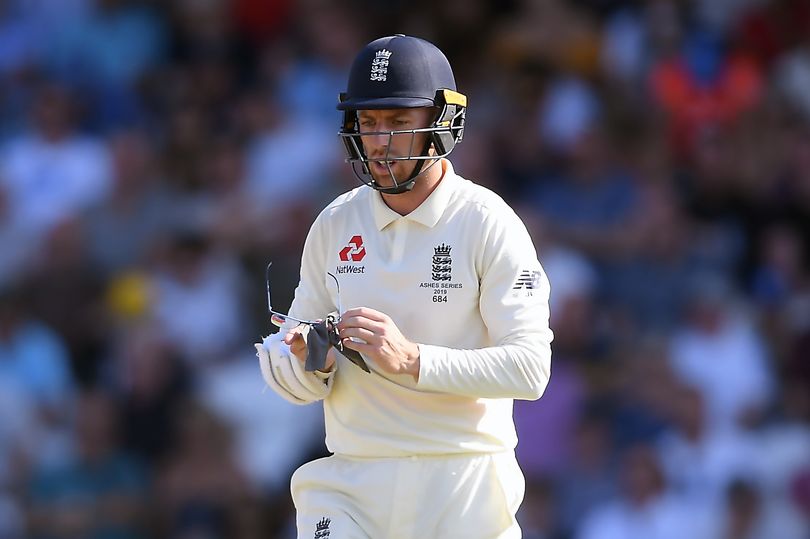
Jack Leach cleans his glasses during his time at the crease.
With only 2 runs to win however, a breakdown in communication looked certain to lose England the match and the Ashes, as Leach took off down the track for a single only to be turned back by Stokes. Certain to be run out, it can only have been divine intervention that caused Nathan Lyon – Australian off spinner – to mishandle the ball at the stumps, giving Leach time to return safely to his crease.
Then, incredibly, with the very next ball, Nathan Lyon trapped Stokes LBW, only for the emphatic Australian appeals to be dismissed by the umpire. Having wasted their last review not too long before this, the Aussies were understandably distraught.
As Jack Leach turned one round the corner to finally get himself off the mark, all eyes were on Ben Stokes with the scores tied. With one final flourish, he cut away Pat Cummins’ delivery, sealing an unforgettable win for England, and reviving their Ashes hopes.
Who says cricket’s boring, eh?!
(Below I’ve included the full 1 hour long broadcast from the moment Jack Leach joined Stokes at the crease, but for those with less of an inclination, I’ve also included a highlights clip)
The full one hour long broadcast of Stokes and Leach’s last wicket partnership.
Full highlights from Day 4 of the Third Ashes Test in 2019.
Honourable Mentions
Istanbul. Liverpool’s sensational comeback against AC Milan. If I’m being honest, this one deserved to be in the top ten, but I left it out for no other reason than that I didn’t want to have to do research on a Liverpool success. Sue me.
Michael Phelps. Christ, this man can swim! One of the most dominant athletes of all time, Phelps’ 28 Olympic medals, 23 of which are gold, makes him the most successful Olympian ever. I also have an affinity towards him because of his honesty and openness when discussing his struggles with mental health.
Pats’ Bowl Comeback. The New England Patriots were down 28-3 in Super Bowl 51. Outscoring the Atlanta Falcons 31-0 from the 3rd quarter through to overtime, they pulled off a quite simply astonishing comeback. Why is this not in my top ten I hear you cry? Because I turned it off and went to bed when they were 28-3 down. I’m still livid with myself.
P.S. You actually read this far?! Haven’t you got anything better to do?
When the New England Patriots’ 2019 season came to an end following a shock upset in their AFC Wild Card matchup against the Tennessee Titans, more than a few eyes began to fall on their quarterback, Tom Brady. Having been with the team for 20 years, whispers were starting to be heard throughout the league that the 2019 season could well be Brady’s last in a Patriots uniform.
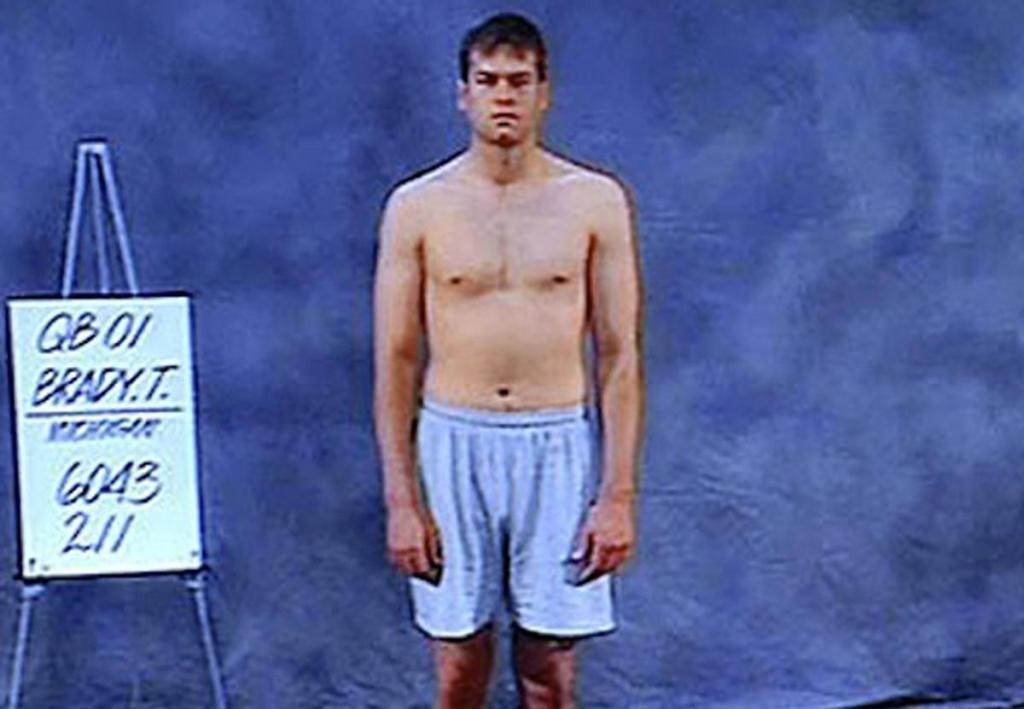
For those of you unfamiliar with the NFL, the significance of this departure may be lost on you. Tom Brady, drafted 199th overall in 2000 out of the University of Michigan, went largely unnoticed as he joined the New England Patriots as the fourth choice quarterback on their depth chart.
Tom Brady was drafted 199th overall in the 2000 NFL Draft.
Very little was expected of Brady as a professional athlete. Many scouts were highly critical of his build and abilities as he headed to the draft; “… he’s just common. He’s very bony, very thin kind of guy. God, you can see his ribs on his build. His arm is just adequate.” Said one NFC scout of Brady, whilst another wasted few words, saying “I don’t like him. Smart guy, that’s it.”
Well, looks can indeed be deceiving. Brady went on to become arguably the greatest quarterback the game of American Football has ever seen. Over a span of 20 years, he took the New England Patriots to 9 Super Bowls and of those, winning 6, including one of the greatest comebacks in sporting history, as the Patriots overturned a 25 point deficit against the Atlanta Falcons, with just over a quarter remaining in the game.
Brady and the Patriots pulled off a stunning comeback in Super Bowl 51 against the Atlanta Falcons.
Tom Brady was the New England Patriots. He wasn’t just the face of a franchise, he was the face of a two-decade-long dynasty.
And now he isn’t..
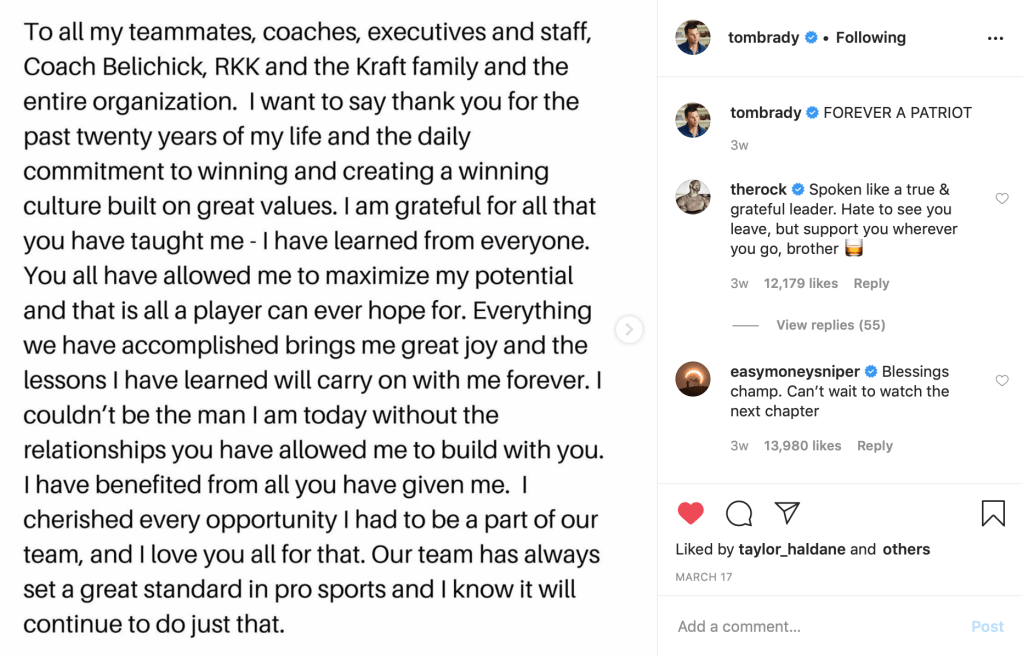
On the 17th of March, Tom Brady announced via social media that his time with the New England Patriots was at an end. In a heartfelt message, he thanked legendary Pats’ coach Bill Belichick, owner Robert Kraft, and the Patriots fans, as the curtain was closed on an unforgettable era in New England.
Brady announced his departure via Instagram.
However, he wasn’t retiring. This wasn’t Brady calling time on his career, oh no. For years, Tom Brady had been accepting team friendly – but still generous – deals, to ensure that the Patriots had the best chance of winning. He did this with the caveat that, eventually, he would want a deal from New England on his terms.
Well, that didn’t happen. Brady’s skills, whilst still considerable, have been in decline over the last few seasons. As such, New England, despite the success Brady brought to them, decided he is surplus to requirements, and allowed him to become a free agent with no intent of resigning him.
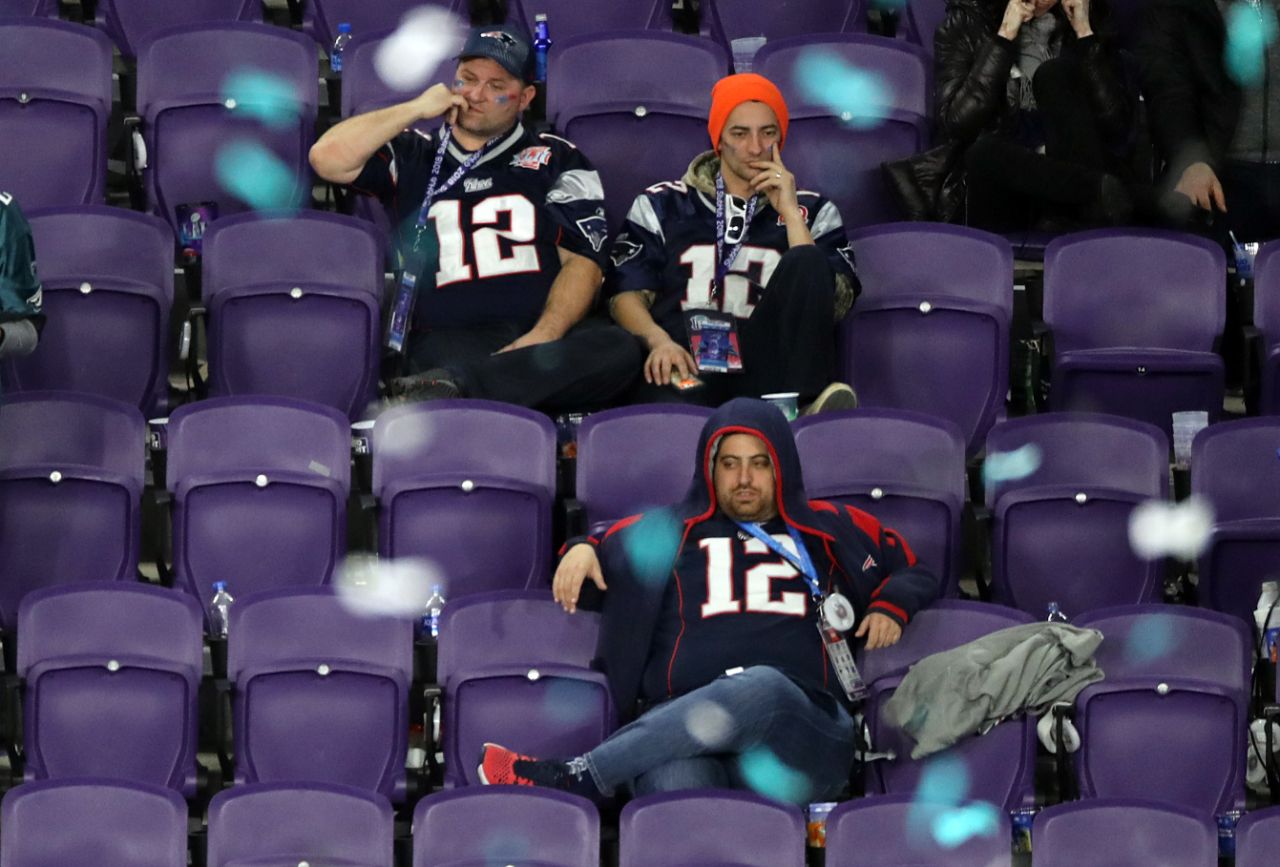
Understandably, Patriots fans are distraught. Since Brady became quarterback, the New England Patriots have failed to make the postseason only twice, in 2002 and 2008. There is an entire generation of Patriots fans who have been raised, not only to hope for success, but to expect it each and every year.
Well, with Brady gone, and no clear replacement in place, this generation of fans are likely to witness the very sharp and very shocking decline of one of sport’s greatest franchises.
Will Jarrett Stidham be the man to fill Tom Brady’s shoes? Or will the Patriots draft a rookie quarterback at this year’s draft?
However, the New England Patriots aren’t the first sports franchise to mourn the loss of their greatest member. In 2013, on the other side of the Atlantic, Manchester United fans watched on as the great Sir Alex Ferguson bid an emotional farewell to Old Trafford, after a 27 year tenure in charge of the club.
Over the course of these 27 years, Ferguson had created a domestic and international powerhouse. Winning 49 trophies, including 13 League Titles, 6 FA Cups, and 2 Champions Leagues, Ferguson’s decision to retire in 2013 left him with a legacy unlikely ever to be seen again in football.
Sir Alex Ferguson lifts the 2013 Premier League trophy above his head.
Ferguson’s departure left an immense void at Old Trafford. Who could possibly come in and fill the shoes that the great man had left? David Moyes? Louis van Gaal? Jose Mourinho? At the time, many fans – myself included – felt that it wouldn’t matter who stepped into the role. Regardless of who was in charge, we were Manchester United, the team that wins.
Oh how naïve I was. Much like that generation of New England Patriot fans, I had been born into an era of total dominance. I had never known what it was like to see Manchester United lose, let alone lose often. I never experienced the years of *shudders* Liverpool’s success under Bill Shankly, or of *shudders* Leeds’ distant achievements.
Yet here I am, 7 years later, deep into the Wilderness Years, hoping that one day a saviour will return to Old Trafford and lift us out of the doldrums. Having to suffer the success of Jürgen Klopp’s 2019/20 Liverpool squad has been the salt in the wound. Our greatest rivals, finally usurping us as England’s best.
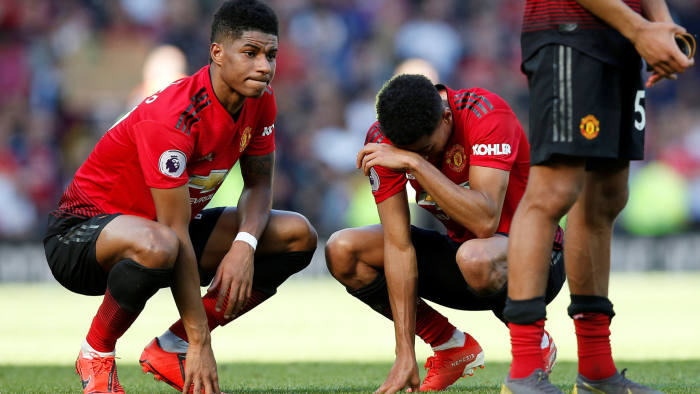
Manchester United have seen a sharp decline since Ferguson’s departure in 2013.
But where does this leave the New England Patriots fans? Well, I suppose the point I’m trying to make, is that for all the mediocrity and ineptitude that I’ve seen from Manchester United over the past 7 years, I would not change the way things have happened. I have realised that the dominance of Manchester United that I grew up during, was a rare anomaly, a sporting Holy Grail that so very few sports fans ever get to drink from.
It was a privilege to enjoy that success, not a right. A level of success and dominance on parity to that of the Ferguson era is unlikely to ever be seen again at Old Trafford; all the more reason to cherish the fact that I was alive to see it and to enjoy it.
So I say to New England Patriots fans, who feel despondent and disparaged; the greatest era of your team’s football may well be over. Mourn it, but do not long for it. Don’t waste your time expecting or hoping for someone to step in and emulate Tom Brady, because, like me, you will waste 7 years of your life angry that it is over, rather than amazed it ever happened.
For now, all we can do is wonder.. can Tom Brady continue his success outside of New England? Will he lead Tampa Bay to their second ever Super Bowl win? I guess time will tell.
After the historic World Cup wins over Ireland and Scotland, the question must now be asked: Is it time to let Japan sit at the top table of World Rugby?
It has been a whirlwind few weeks for Japanese rugby. Becoming the first ‘Tier 2’ nation to host The Rugby World Cup is an enviable achievement in itself. However, the way in which the Brave Blossoms have successfully navigated Pool A, leaving Ireland, Scotland, Samoa, and Russia in their wake has captivated not only the hearts and minds of the nation, but the rugby world.
Ireland, top of the world rankings coming into the tournament and fresh off the back of a commanding victory over Scotland, simply had no answers to Japan’s intensity across the pitch. The Irish could not blame the short turnaround, their own indiscipline, or even the loss of the talismanic Johnny Sexton for the result. On 28th September they were simply outplayed by a stunning Japanese performance in Shizuoka.
Scotland had recovered somewhat in style, not conceding a point against Russia and Samoa following their 27-3 opening weekend drubbing at the hands of the Irish, and were tipped by many to have the better of the Japanese in the crunch game in Pool A. Scotland, needing to take at least 4 more match points than their Pool A rivals, started the game brightly. But, in similar fashion to the Irish, were blown away by Japan’s scintillating intensity and pinpoint accuracy.
Looking at the final standings in Pool A, a rugby novice would be forgiven for thinking there had been a mistake.
Pool A Final Standings. (World Rugby)
Japan finished top with 19 points out of a maximum of 20, ahead of Ireland who follow them into the Quarter Finals. Many have spoken of the ‘shock’ Pool A results. But was this really such a shock?
Ever since World Rugby announced in 2009 that Japan would host the RWC2019, this nation has been preparing for the most important games in its history.
The 10 Year Process
21st June 2009.
New Zealand have just defeated England 44-29 to win the 2009 IRB Junior World Championship Final in Tokyo.
The Japanese finished bottom of their Pool after defeats to England, Samoa and Scotland, and have just defeated Uruguay to avoid collecting the wooden spoon. They can take little inspiration from the Nation’s senior team, languishing at 16th in the world rankings, only slightly ahead of Romania and Russia. There is work to be done if Japan wish to compete with the world’s best in 10 years time.
The 2011 World Cup in New Zealand gave Japan an insight into how to effectively host a Rugby World Cup, perhaps more of an insight as they would’ve liked, with New Zealand cruising to a 83-7 win when the sides met in the pool stage. The Kiwis went on to lift the Webb Ellis Cup in front of their home fans in Eden Park, Auckland, but on-field problems remained for the Japanese, again finishing bottom of their pool, as they did in 2007.
Between the conclusion of the 2011 World Cup and the beginning of the 2015 edition, marked improvements could be seen in Japanese performances and results. Entering the tournament ranked 13th in the world, Japan delivered one of rugby’s greatest ever shocks, overcoming one of the pre-tournament favourites South Africa by 34-32 courtesy of a try with the clock in red.
In 2015, Japan became the first team ever to win 3 pool games and fail to progress to the Quarter Final stage of the World Cup. The only team to beat them then? Scotland. By a commanding scoreline of 45-10. A quick glance at the 91-3 and 72-18 demolitions just eight years previously at the hands of Australia and and Wales respectively, in comparison with Japan’s performances at the 2015 RWC should serve as an indicator of where this team was, and is, heading.
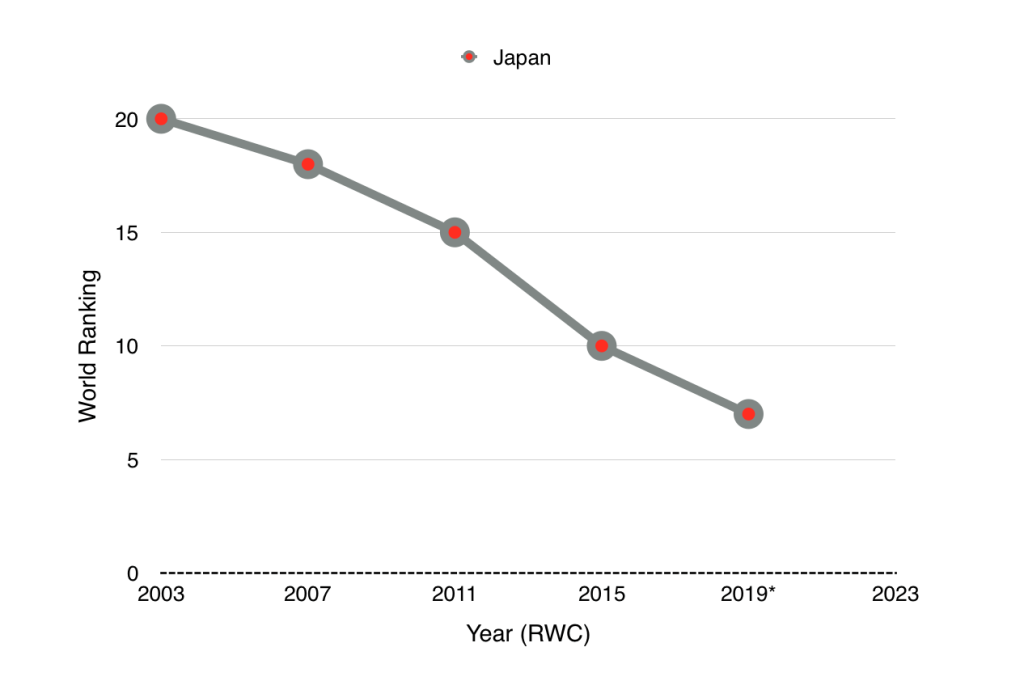
The graph below displays how Japan’s Rugby World Ranking has improved over the years. Each year is a World Cup year and the ranking is taken from the year-end.
Improvents in Japan’s Rugby World Ranking
Following Sunday’s triumph over Scotland, Japan have risen to a highest ever ranking of 7th in the world. Should the vast improvements made over the years continue, the likes of New Zealand, Wales and England should be wary. They would be naive not to be already peering over their shoulders.
What next?
Peak viewing figures for Sundays match show that 53.7% of the Japanese population tuned in to watch their nation triumph. Those figures represent roughly 60 million viewers, highlighting how the interest in the sport exists.
No matter what happens in Sunday’s quarter final showdown with South Africa, Japanese Rugby has already won. The heroics of 2015 were merely put down to a ‘fluke.’ There is no question of a fluke this time, Japan have arrived. And they can play.
Rugby fans, players and pundits across the world have taken note of Japan’s ability to convert their natural culture of hard work and accuracy into rugby success.
The infrastructure is there, the interest is there, and the rugby ability is there in abundance.
There is no question that Japan possess the talent within their ranks. Winger Kotaro Matsushima is joint top try-scorer at this years World Cup with 5, with another winger, Kenki Fukoaka only one score behind. Fly half Yu Tamura is the competitions leading points scorer with 48.
Each Japanese performance has been littered with individual and collective brilliance. Hooker Shota Horie, Centre Timothy Lafaele, scrum half Yutaka Nagare and veteran loose forward Michael Leitch are providing breathtaking sparks of rugby genius all over the park.
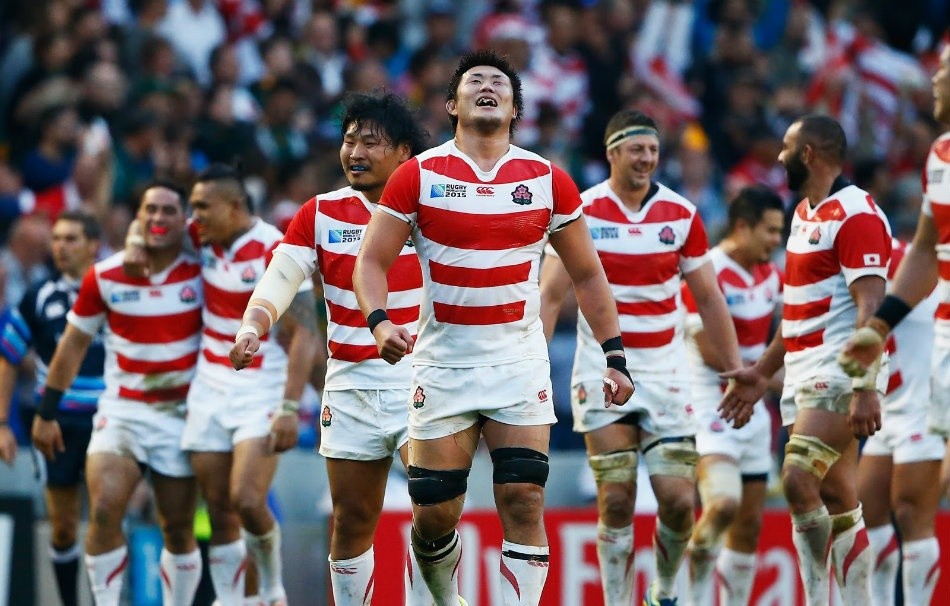
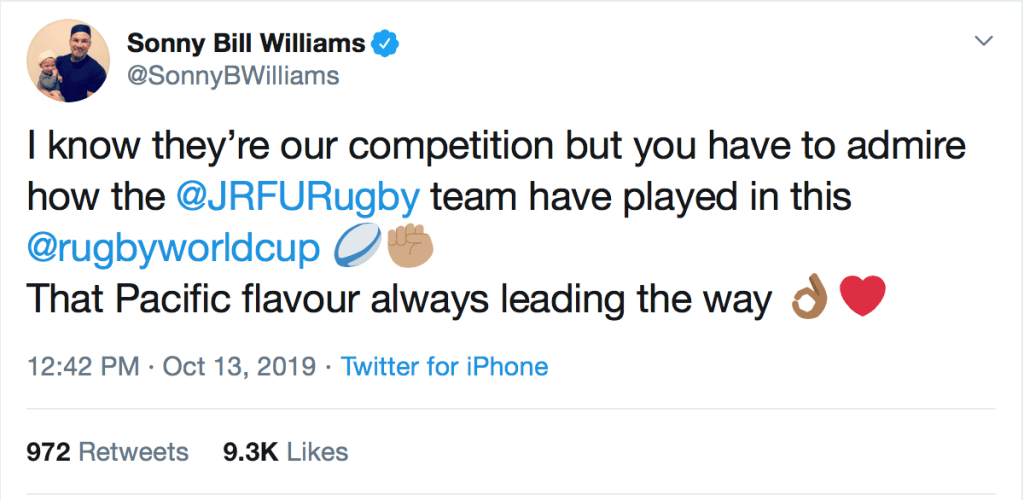
Japan have received high praise, including from All-Blacks legend Sonny Bill Williams
The time has come for World Rugby to support Japan in their jump to the next stage.
Geographically, despite Japan’s Northern Hemisphere location, it would make a lot more sense to enter into The Rugby Championship, alongside New Zealand, South Africa, Australia and Argentina.
World Rugby’s definition of a ‘Tier 1’ Nation is any team that plays in The 6 Nations or Rugby Championship. It is evident that Japan have surpassed the level played by Italy, can compete successfully with Scotland and Ireland, and have made it further than Argentina in this World Cup.
To put it simply, following this World Cup, World Rugby must ensure that Japan becomes a ‘Tier 1’ Nation within the next 12 months. If rugby is to take advantage of the Asian market, and support Japan’s stellar rise, they must play against the best on a consistent basis. Included in this must be the reintroduction of the Tokyo-based Sun-wolves franchise team to Super Rugby. Failing this, investment and media must be thrown at the domestic teams and leagues.
Sunday’s quarter final against South Africa will bring with it an opportunity to further inspire a nation. While it will be a momentous challenge to repeat the ecstasy of 2015, one thing is for sure: Japan will not go down without a fight. Looking past Sunday and indeed the remainder of this historic tournament, Japan has entered a hugely exciting new phase in its rugby development, not only for the benefit of Asia, but also for the rugby world.
And so we ask: Is it time to let Japan sit at the top table of World Rugby?
I’ve always loved America. I’ve always loved sport. But I
never really loved American sport. I couldn’t
find them engaging or interesting. Basketball bored me. Baseball was glorified
rounders. American Football was a poor man’s rugby.
Now though, I’ve realised that the only reason I didn’t like
them, was because I didn’t watch them.
When I was younger, there wasn’t much opportunity for me to watch the NFL, or
the NBA, as no British broadcasters had the rights to air them. I watched the
more traditional ‘British sports’ such as football, cricket, rugby, and so on, simply
because they were the most accessible to me.
With the advent of universal streaming platforms however,
this began to change. People around the world were being given the opportunity
to watch programmes that had never been broadcast in their country. And, as these
platforms began to garner some serious popularity, they began to dip their toes
in more and more content, inevitably
making a splash in the world of sports.
As a result, when Amazon Prime came along and subsequently released their All or Nothing docuseries in 2016, my attitude towards the NFL, and towards American sports, was changed. I was exposed to the world of American Football in a way I’d never experienced before. I was shown the cogs behind the wheel of the game I’d dismissed as ‘too slow’.
Amazon Prime’s first season of All or Nothing, following the Arizona Cardinal’s 2015 season.
All or Nothing made me understand and appreciate the meticulous level of detail that makes American Football what it is. I now understood why the game had so many stoppages, so many ads and so many pads, and why it was ‘America’s Game’. It had me hooked from the first episode.
As I began to immerse myself in this previously unknown world,
my understanding and interest just kept growing. I decided, for
better or for worse, to support the Arizona Cardinals. I began to keep an
eye on mock drafts and I started reading up on players I should look out for.
The Draft allows each of the 32 NFL teamsto select from the nation’s best college playersin reverse order of the previous season’s finish.
I say all of
this with a caveat however, and, given everything I’ve written up until this
point, I would understand if you found yourself confused. In short, as much as
I love the sport, the NFL organisation and administration is morally bereft and
inherently flawed.
If this wasn’t
made obvious by the league’s past
dismissal of the health risks playing the sport posed to its stars, then I implore
you to look at the example of Colin Kaepernick as a more contemporary example.
For those of
you who may be unfamiliar with Kaepernick’s story, he was the first footballer to
protest
racially motivated police brutality by ‘taking a knee’ during the national
anthem in 2016.
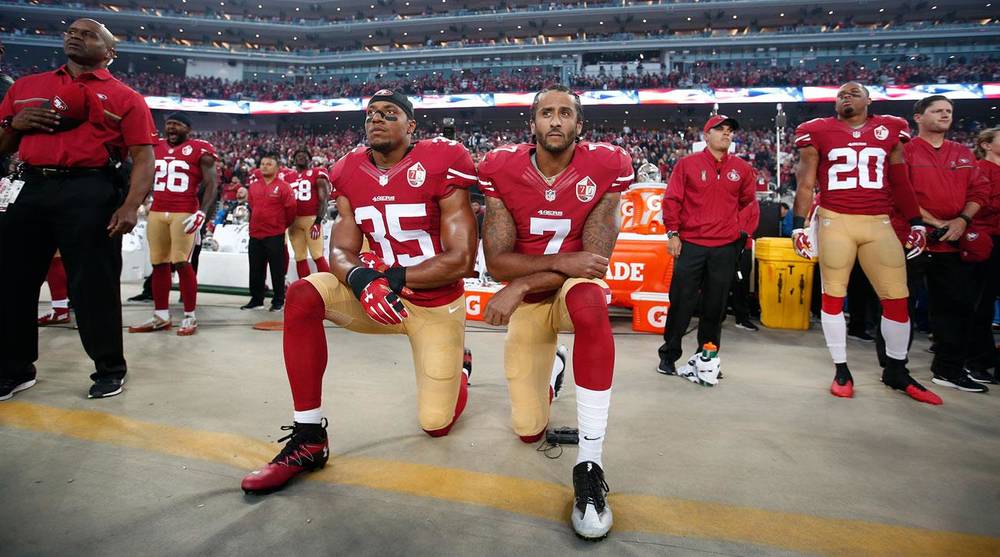
Colin Kaepernick (R) and San Francisco 49ers teammate EricReid (L) kneeling during the American National Anthem.
As a result, he started a social movement, the scale of
which hadn’t been seen since that of Martin Luther King. Hundreds
of other NFL stars followed his example, taking a knee or raising a fist,
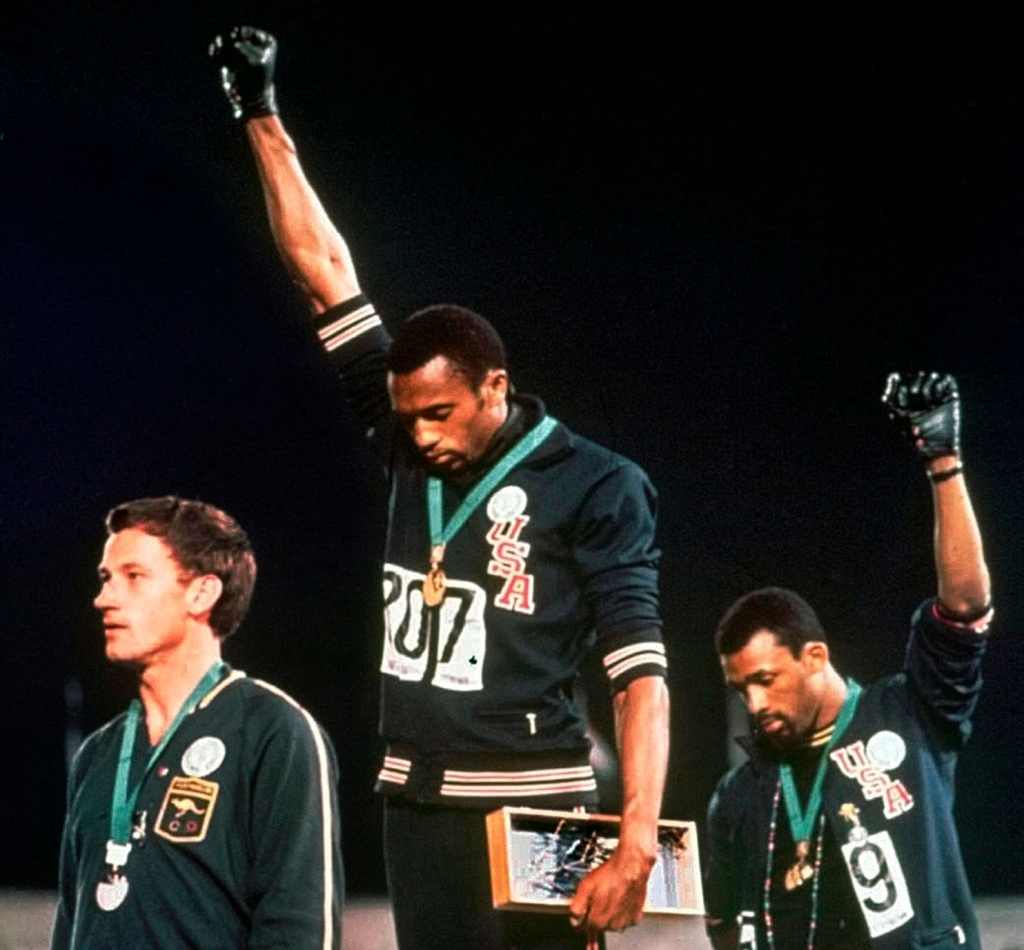
reminiscent of Tommie Smith and John Carlos’s pose at the 1968 Olympics.
Tommie Smith (C) and John Carlos (R) raising gloved fists in a Black Power Salute, during the American National Anthem, after winning gold and bronze respectively in the 2OOm sprint at the 1986 Olympics.
Kaepernick’s reward for taking such an admirable stand, was to be made a pariah by the NFL and the wider community. Having opted out of his contract with the San Francisco 49ers in 2017, he has not been picked up as a free agent by any team, despite winning the NFC Championship and leading the 49ers to the Super Bowl in 2012. He remains, in effect, in exile from the NFL.
You may be
thinking that this is fair enough. You could easily argue that Kaepernick poses
too much of a financial risk to most franchises in the league. If Kaepernick,
no matter how just his protest may be, alienates the fans who pay good money for
tickets, then it makes financial sense not to hire him.
My problem with
Kaepernick’s unilateral exclusion is not with the NFL’s decision never to hire
him again, but with its decision to make him unique in this regard.
Nike used Kaepernick in an advert that divided America once again, leading many to boycott the popular brand.
When you have
the likes of Kareem Hunt, Ezekial Elliot, Ben Roethlisberger, Reuben Foster, and
Julian Edelman, all still playing in the league, you can understand my frustration.
Allow me to elaborate.
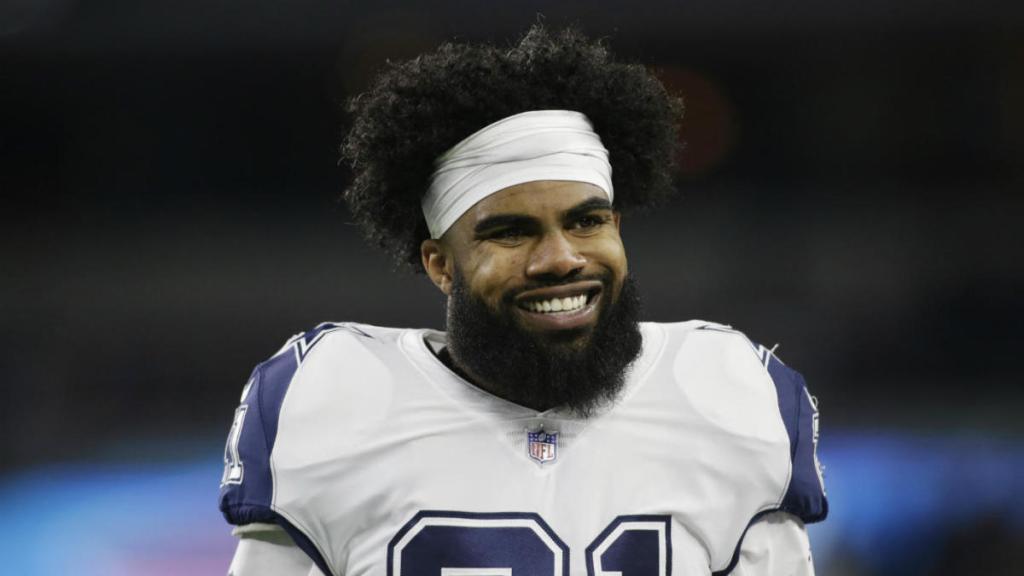
Dallas
Cowboys phenom, Ezekial Elliot, enjoyed a particularly turbulent year in 2017,
when he consistently
denied multiple domestic violence accusations. The NFL found enough
evidence to hand him a 6 game suspension, which he appealed. His appeal lasted
for months – during which time he was allowed to play – until November the 15th, when he eventually
dropped it. Throughout this time, he was supported by his team, and he remains
a Cowboys player.
Dallas Cowboys star running back, Ezekial Elliot.
Ben
Roethlisberger, veteran star quarterback for the Pittsburgh Steelers, was accused
of sexual assault on two separate occasions. The first in 2009 and the
second in 2010. The first charge was settled out of court, whilst the second
victim elected not to press charges against Roethlisberger. The NFL handed him
a 6 game suspension which was later reduced to 4. He remains the Steelers’
starting quarterback.
Julian Edelman won the MVP award for his performance in Super Bowl LIII.
The NFL is a
machine fuelled by greed. These players weren’t kept on by their respective
teams or signed by others because they believed their sides of the stories,
they kept them on because they simply didn’t care. As long as they have the
potential to win them games, and as long as fans keep paying to see them, NFL
franchises don’t care what skeletons their players might be keeping in the closet.
And yet.. was
Kaepernick not a game winner? Had he not achieved success with the 49ers? In
this case, you could argue that it wasn’t the NFL that made the decision to
exclude him. Their hand was forced by the only people that can hold any sway
over the all-powerful organisation; the fans, the people who keep them in pocket.
When they turned against Kaepernick, they sealed his fate.
So now we
come to the real problem with the NFL, and more importantly, the real problem in
America. What does it say about these people, these fans of the NFL, that they are
willing to crucify a man whose only crime was to stand up for something he
believed in, and yet they will worship drugs cheats, sexual abusers, and the uncontrollably
violent?
It speaks volumes for the societal mindset in America, when millions of people across the country are outraged by a man kneeling during their national anthem, a harmless act in a peaceful protest, but will turn a blind eye to the unnecessary violence and discrimination that he is trying to prevent.
As the first test in the 2019 Ashes series drew to a close yesterday,
with Australia upsetting England at Edgbaston, there were some notable
performances to look back on. However, whether it was Nathan Lyon’s spell with the
ball on day 5 or Rory Burns’ maiden Test hundred, all were overshadowed by
one man’s individual performance.
As Australia found themselves floundering on 122 for 8 in their first innings, they desperately needed a performance from one of their 3 remaining batsmen if they were to have any chance of getting a result out of this Test. Step forward Steven Peter Devereux Smith.
Smith’s sublime 144 runs in the first innings almost single-handedly
dragged Australia back into the Test, offering a clinic in technique, patience,
and desire. He then proceeded to back this performance up with an equally
superb 142 runs in Australia’s second innings, making him only the fifth ever Australian
batsman to score a ton in both innings of an Ashes match.
The real reason Smith’s efforts with the bat in this first Test were so impressive, can be attributed to his mental resilience.
Test cricket is, in essence, an examination of a player’s patience,
decision making, and concentration. It is as much a test of the mind as it is
of skill. So when we take into account what Smith had gone through over the
course of the past 18 months, his performance in this Test was nothing short of
phenomenal.
On the 24th of March in 2018, during the 3rd Test between South Africa and Australia, Australia’s Cameron Bancroft was caught by TV cameras using sandpaper to rough up one side of the ball in an attempt to generate extra swing during its flight, something that is highly illegal within the parameter of cricket.
The footage of the event makes for difficult viewing. It is so blatantly obvious what Bancroft was doing. Millions of people around the world saw it in real time, and you can almost imagine these fans across the world, sitting on the edge of their seats, wide eyed in disbelief.
Following an investigation
into the incident by Cricket Australia a few days later, it was discovered
that it was Warner who had conceived the plan and instructed Bancroft how to carry
it out, going as far as to give him a demonstration of how to tamper with the
ball. Smith was found to have prior knowledge of the plan, and was sentenced
with Warner to a 12 month suspension from international and domestic cricket,
whilst Bancroft was dealt a 9 month sentence.
So flash forward over a year later, to the 1st of August, 2019, as Steve Smith walks out to the middle of Edgbaston in the first innings of the first Test of The Ashes.
For most of these players, this Test is significant as it is the first of the Ashes series. For Smith, it is much, much more. It marks his return to the Australian Test side since his ban.
Unsurprisingly, he, like Warner and Bancroft before him, is greeted
by a cacophony of boos. Some of the English Barmy Army have donned masks of the
former captain in tears, others are waving sandpaper in the air suggestively. Smith
had entered the lion’s den.
The Barmy Army, renowned across the world as passionate English fans.
But he was impenetrable, and he was fantastic. Smith had
heard the boos. Of course he had. But, for whom they were for, he simply didn’t
care. He had waited over a year for this moment, and he would make damn sure he
seized it.
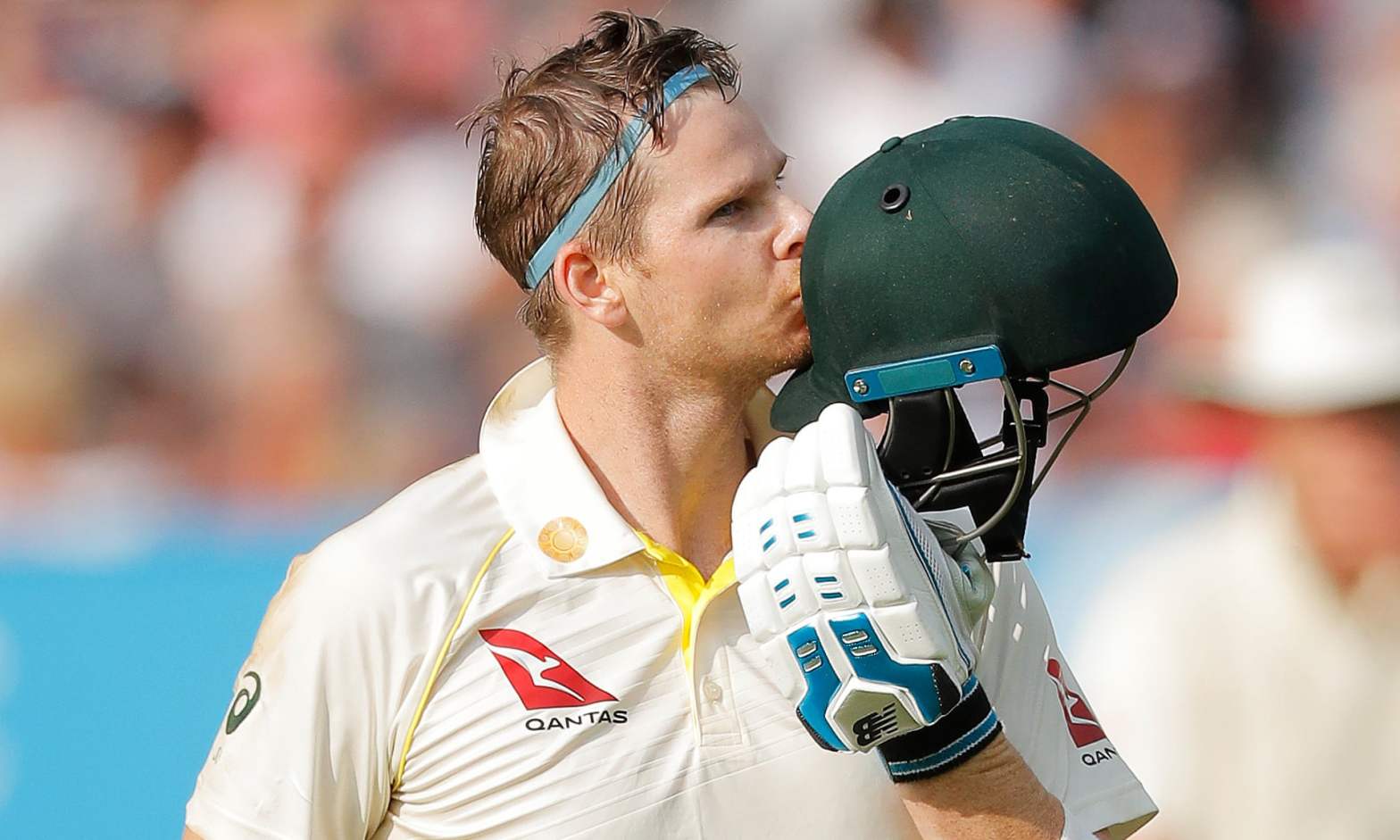
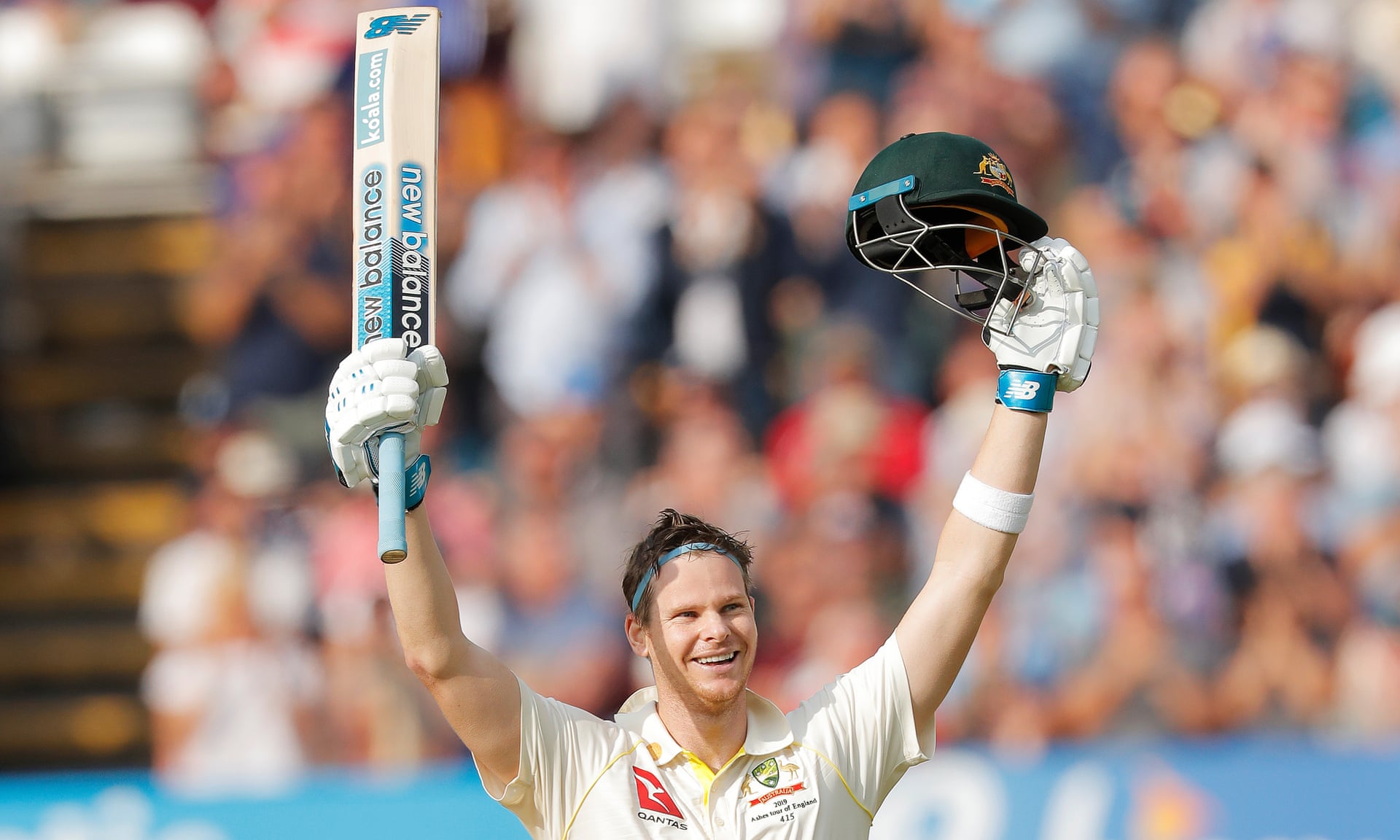
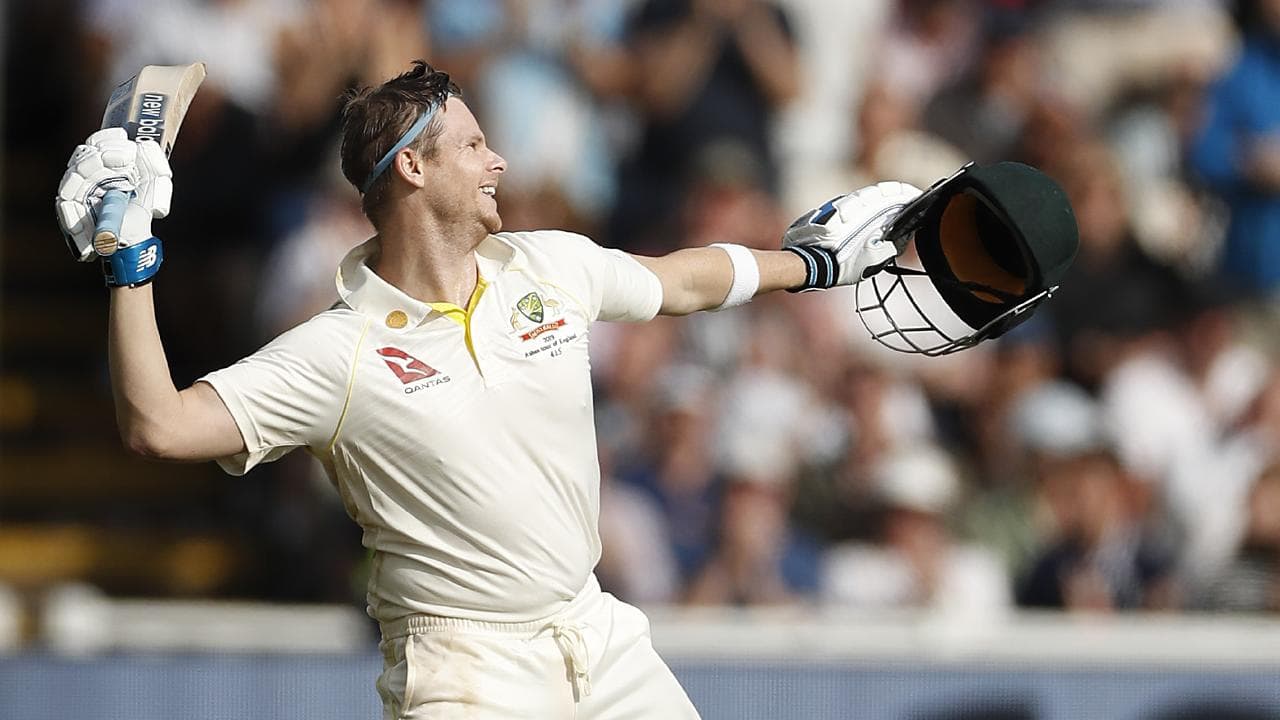
As he removed his helmet and raised his bat over five and a half hours later, he had defeated his demons. He had conquered himself as much as he had conquered England’s bowling attack. The relief and emotion that Smith experienced in this moment was clearly apparent on his face.
Smith celebrates reaching his hundred upon his return to the Test side.
Once more, he was greeted by a chorus of boos. This time however, the Barmy Army were booing on their feet whilst clapping their hands. They had witnessed one of the game’s greats deliver a performance like no other.
Smith continued this batting exhibition into Australia’s second
innings, as he posted 142, propelling Australia to an unlikely position of
ascendancy at a ground many pundits and fans regarded
as a ‘fortress’ of English cricket. His performance earned him the Player
of the Match award, his closest opposition to the accolade probably being his
compatriot, Nathan Lyon.
His brilliance, his skill, and his strength of mind
throughout the match amounted to Smith’s redemption for the likes of Nasser
Hussain and Shane Warne. He had served his ban, and he had come back to
reignite Australian cricket under the most critical of microscopes; Ashes cricket.
But had Smith redeemed himself? I’m not so sure. For me,
Smith, Warner, and Bancroft will never redeem themselves. Their careers are marked
by an asterisk forever more. Not, as is most common in cricket, to suggest they
are ‘not out’, but more as a reminder that they were caught – for lack of a
better word – cheating.
The Barmy Army won’t forget Smith’s ‘mistake’ for the rest
of this series, and indeed, very few cricket fans will forget it as long as
they continue to play – such was the scale of this scandal.
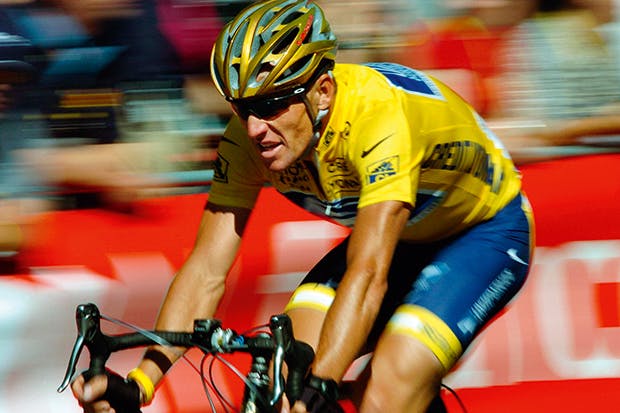
Lance Armstrong, responsible for one of the most infamous sporting scandals of all time.
In a world that has seen Lance Armstrong stripped of 7 Tour de France medals, the Russian state systematically doping their athletes, and Maradona’s Hand of God, you could argue that what Smith and co carried out is relatively inconspicuous. However, cricket is renowned worldwide for being ‘a gentleman’s game’. It prides itself on its rules, etiquette, and tradition. So for some of the sport’s biggest names to be caught trying to obtain an illegal advantage, it is going to send major shockwaves throughout the sporting world.
As a fan of cricket, and as a fan of Steve Smith, I was so
disappointed when this scandal was brought to light. It reminded me of the age
old adage that you should never meet your heroes, because they’ll always
disappoint you.
I felt let down. It made me sceptical and cynical about a
game I had loved for years. I’m not naïve however. I understand that at a higher,
administrative level of cricket, corruption is rife (as is explored in the great
documentary, The Death of a Gentleman).
But I was hopeful. I had faith that the game was played fairly and justly by
the players. Maybe I am naïve after all…
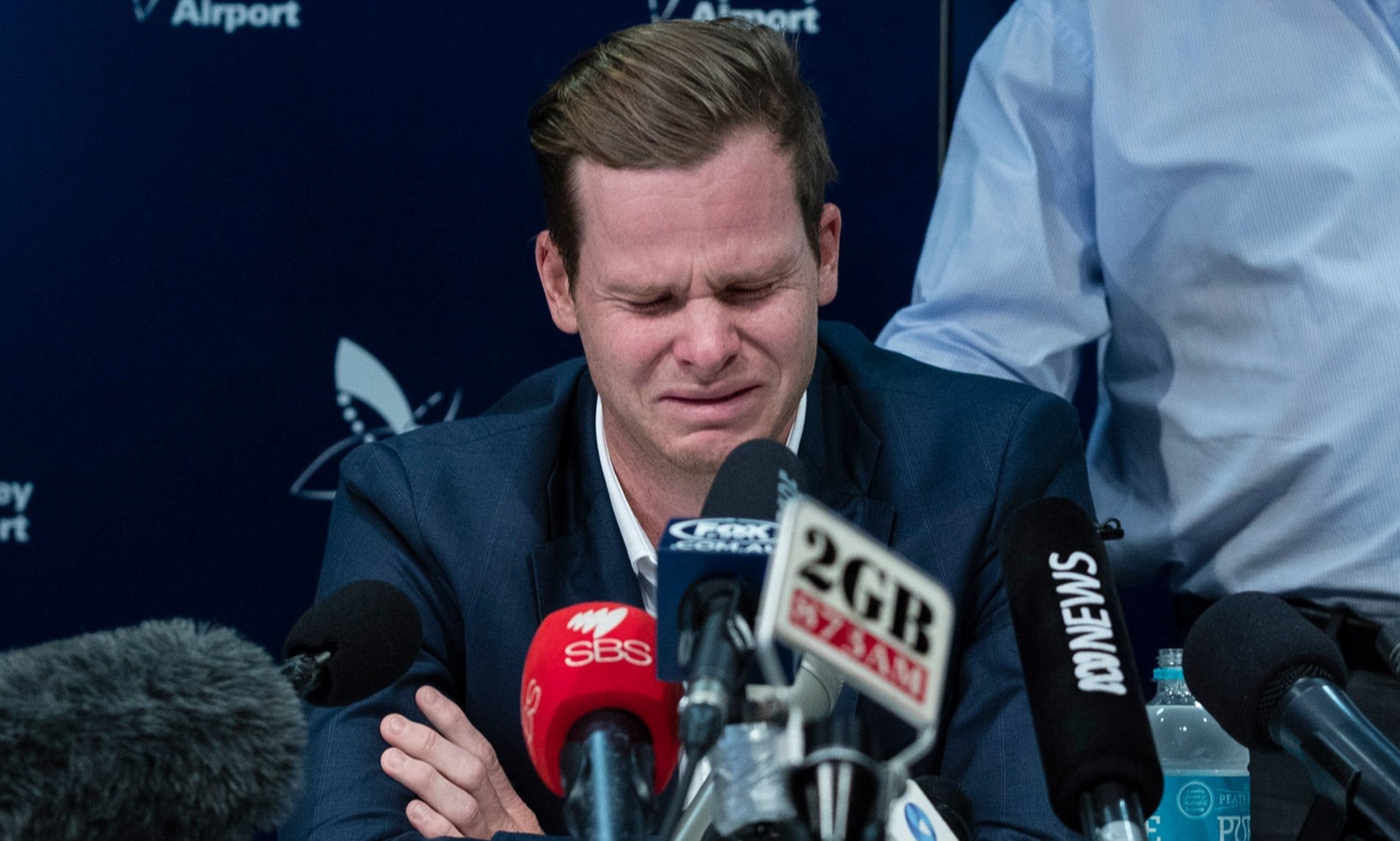
Smith can’t contain his emotion as he faces questions from the media.
A degree of my hopefulness was restored thankfully, as I watched
the interviews following the scandal, in which Warner and Smith display great
emotion and sadness. The impression I got from the interviews was that Warner
was disappointed and upset, not because of what he did, but because he was caught.
Smith however, gave me the feeling that he genuinely regretted what he did. Yes, he let his team and his country down, but the emotion he showed as he gave his interview suggests more to me, that he knows he had let himself down. He appeared fallible and human. He had made a mistake, something we could all relate to.
And, as sad as I am that Smith tarnished his name in the way
he did, I am so glad that he has been allowed to return to the game that he
loves. Why? Because I love it too, and I love watching him bat. His unorthodox
style, his idiosyncratic routine before each ball, his determination, his composure,
his patience and his aggression. He is one of the greatest batsmen ever to pick
up a cricket bat, and to me, it would be a great shame if the game of cricket
were to turn its back on him as a result of one, silly mistake.

















 Views From The Sticks